
A semantic framework for meaning-driven systems
Syx Framework separates meaning from structure, allowing systems to evolve, interoperate, and scale without losing coherence.
It does not execute systems. It executes meaning.
Syx Framework separates meaning from structure, allowing systems to evolve, interoperate, and scale without losing coherence.
It does not execute systems. It executes meaning.
Traditional systems are tightly coupled to their underlying structures. Data models, formats, and interfaces change frequently, breaking consistency and increasing overhead.
Forced harmonization leads to hidden costs and limited flexibility.

Data meaning is embedded inside fixed schemas. When structures change, systems break.

The same information is described using multiple formats across different systems.

Data must be repeatedly translated and reinterpreted to be reused.

Structural complexity creates invisible operational and maintenance costs.
Meaning remains consistent even when structures change.
Syx Framework decouples semantic understanding from structural forms.
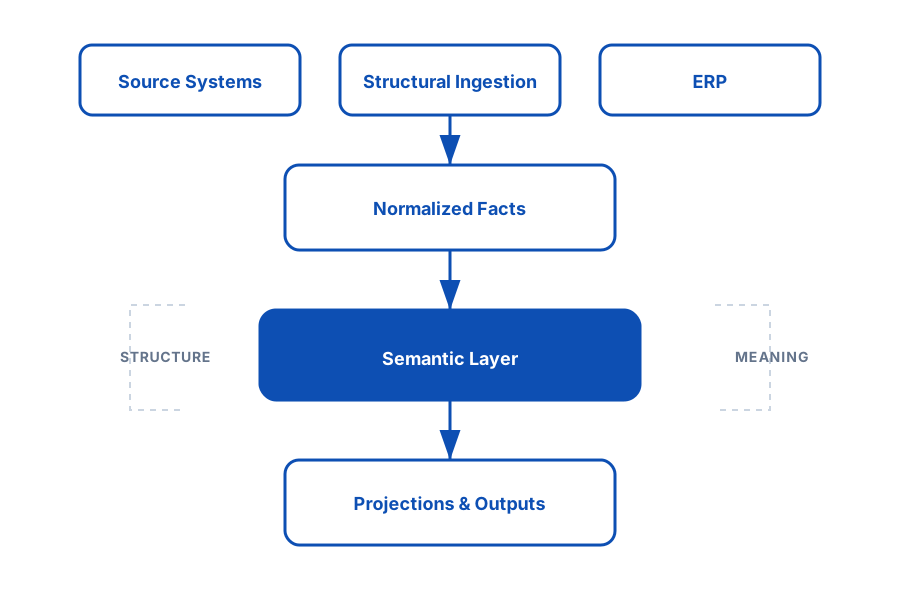
Once meaning is decoupled from structure, systems can evolve without breaking coherence. The Semantic Layer becomes a stable reference that outlives formats, schemas, and technologies.
Syx Framework is a semantic framework designed to preserve meaning independently of structural implementations. It defines how meaning is modeled, referenced, and maintained across systems.
Syx does not execute systems. It defines meaning so systems can evolve without redefining what information represents.
The difference introduced by the Semantic Layer is not about new technology, but about how meaning behaves when systems change.
By separating semantic meaning from structural form, Syx enables systems to evolve without losing coherence or continuity.
The Syx Framework is applicable wherever meaning must remain stable while systems, formats, or technologies evolve.
In all these contexts, Syx acts as a semantic anchor: systems change, but meaning remains consistent.